Product Overview
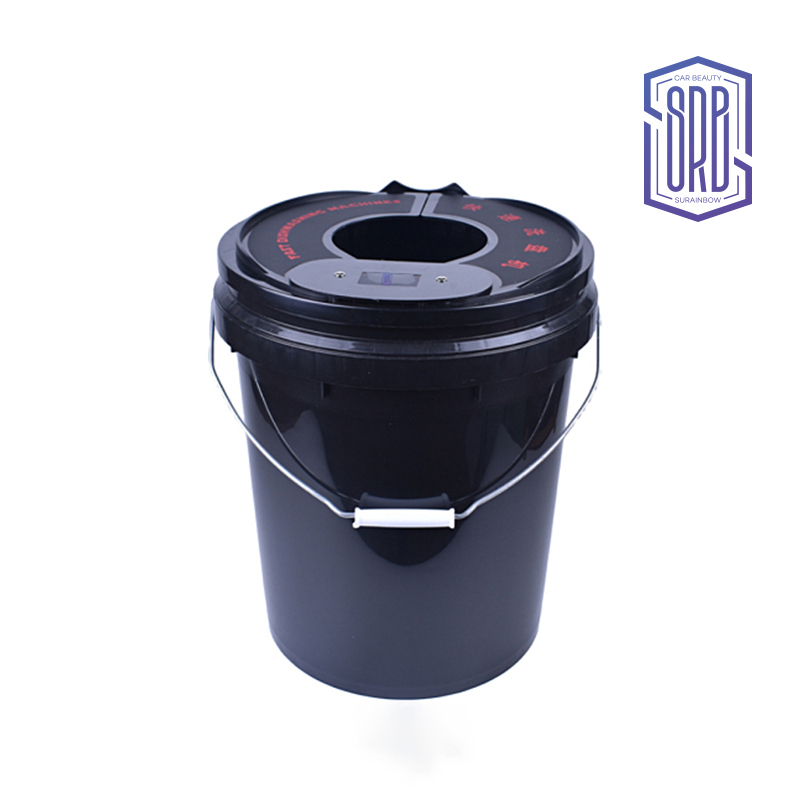
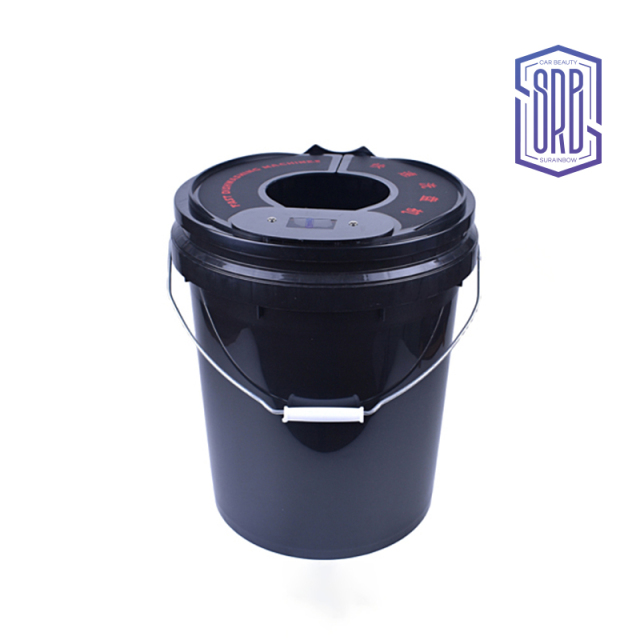
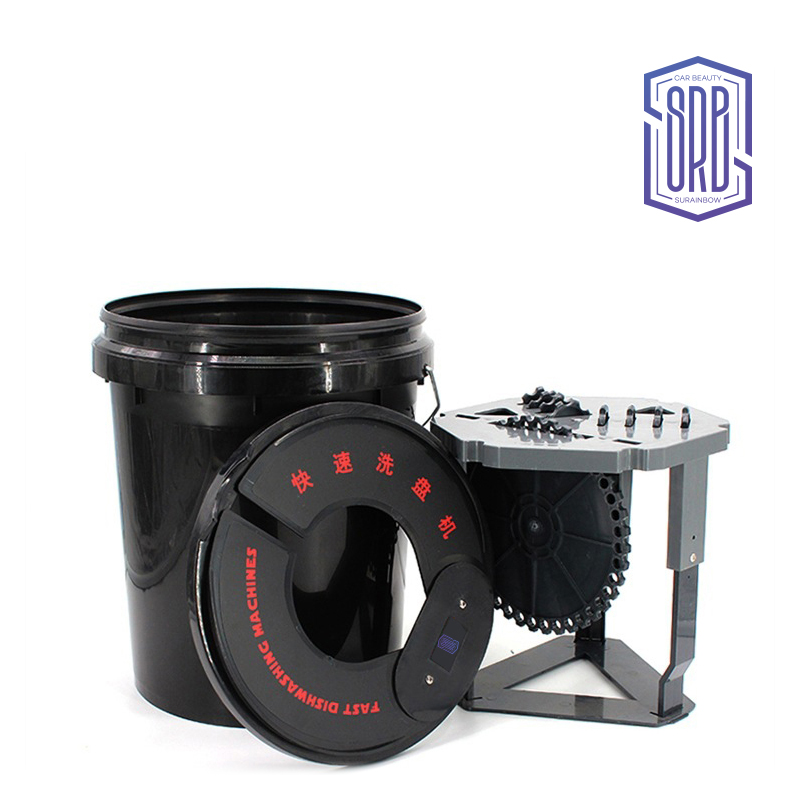
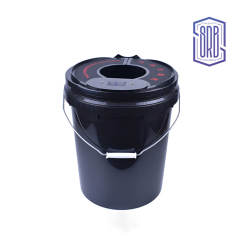
The professional quick pad washer is a floor-standing washing station for foam polishing pads: one moulded plastic body, a removable lid and the inserts that hold the pad in place inside the bucket. It takes up the footprint of a wash bucket, so it sits beside the polisher without eating floor space.
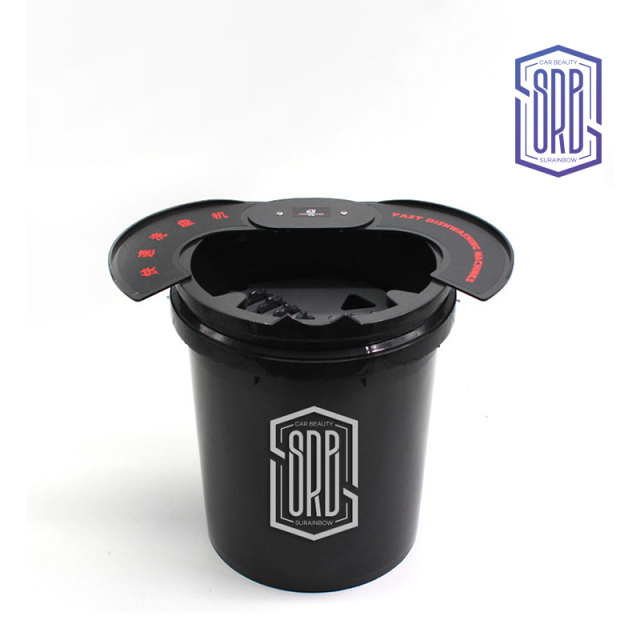
The pad goes in face-down through the central opening in the lid and rests on the slotted insert, which holds it in a fixed position while it is worked. Because this polishing pad washer bucket keeps the pad located, both hands stay free for the water and the turning — nobody is left chasing a pad around the bottom of a bucket.
A pad does not stop carrying compound when it comes off the machine. Washing between panels keeps cutting residue out of the next section, and washing between vehicles keeps one car's paint residue away from the next car's finish. A fixed station makes that step happen every time rather than only when somebody remembers to fetch a bucket.
Most bays already rinse pads; the question is where the dirty water goes. Rinsing over a drain or in the wash bucket spreads slurry across the floor and mixes the rinse water with everything else in use. A dedicated detailing pad wash bucket keeps the pad, the water and the residue in one container that is emptied and rinsed in a minute at the end of the shift.
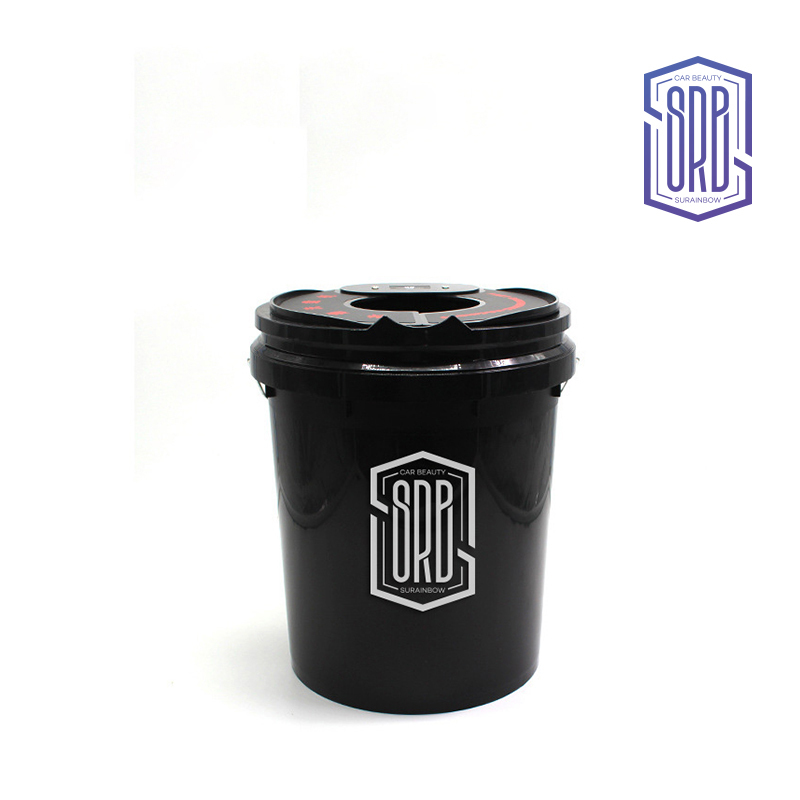
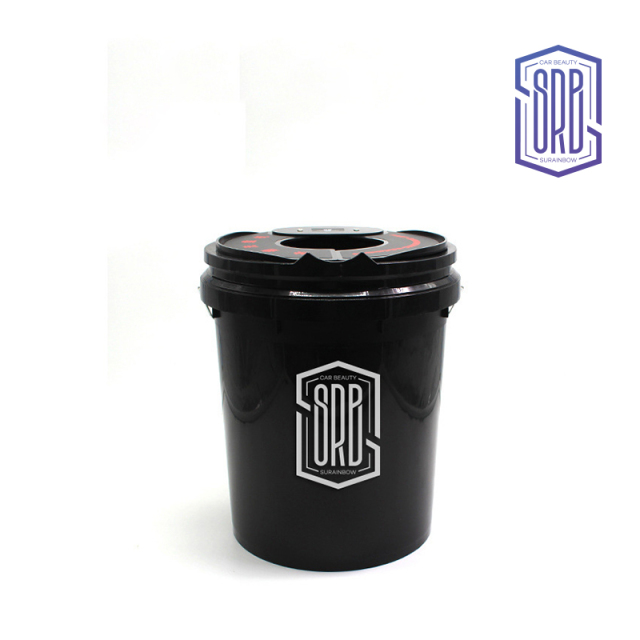
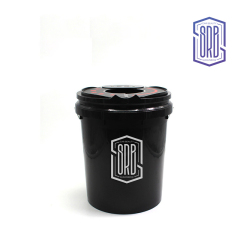
As your car wash bucket supplier, we ship it ready to work: glossy black with SURAINBOW branding on the front panel, nothing to assemble and nothing to fix down, so the station is working as soon as it has been filled.
Pad Washing Routine
- Set the polishing pad washer bucket where the polishing happens — level floor, within reach of the polisher and the water supply, with room to lift the lid clear.
- Fill the detailing pad wash bucket to a working level: enough clean water to cover the insert, with a little pad shampoo if your process uses one.
- Seat the pad face-down through the opening in the lid onto the slotted insert, keeping the backing flat so the foam takes the contact evenly.
- Press and turn the pad in short passes, working around the face so no area is missed.
- On a foam polishing pad washer the water and the insert do the loosening, not your grip.
- Lift the lid, take the pad out and rinse it in clean water, with a second rinse if it came off a heavy cutting step.
- Drain and refill after cutting pads, before the polishing and finishing pads go in, so heavy residue does not travel to the last pass on the car.
- At the end of the shift, empty the bucket, rinse the insert and the lid, and leave the station open to the air so nothing sits wet overnight.
Key Features
- A working height that keeps you upright: this foam polishing pad washer presents the pad at the top of the bucket, so a shift of pad changes is done standing, on a wet floor, without kneeling.
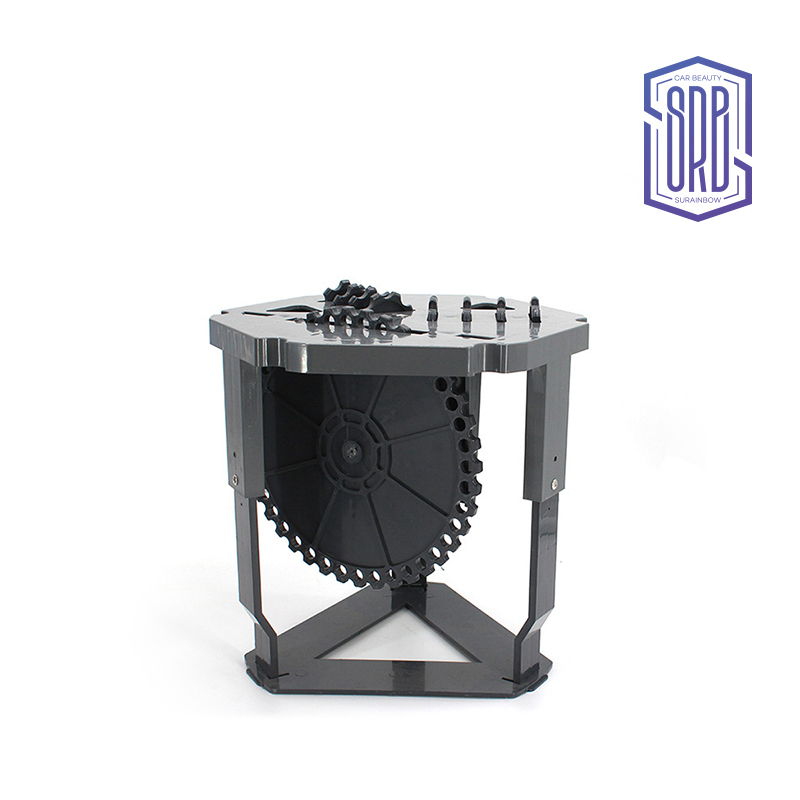
- Residue drops below the pad: the rotating insert holds the foam off the bottom of the bucket, so compound and paint residue settle underneath and the water around the pad stays usable for longer.
- The lid comes off and the vessel changes job: with the lid set aside, this detailing pad wash bucket takes pads that need a longer soak, and the lid lifts away without tools or clips.
- Smooth, wipe-clean body: moulded plastic with no fabric cover, exposed fixings or deep recesses to hold compound, so a cloth pass keeps the station looking like equipment rather than a used bucket.
- Nothing to set or adjust: used as a car polishing pad cleaner, the station works from a fill of water and a minute of hand work — no settings to learn, no parts to clog and no separate rinse tray to keep track of.
Applications
Detailing studios: where two or three polishers run at once, a car polishing pad cleaner earns its place between the machine and the bench. Used pads go straight in, fresh ones come back into rotation, and fewer pads are retired half-used because they were never properly rinsed. High-volume wash bays: the station is used by whoever picks up the polisher that day. A fixed method — fill, seat, work, rinse, drain — means a newer operator cleans a pad the same way a senior detailer does, which matters when one set of pads is shared across a shift. Dealership and fleet prep: in-house prep teams polish a handful of cars a day and rarely have a cleaning area of their own. The station takes no more floor space than the polishing pad cleaning bucket it replaces, and it can be moved when the bay is reorganised. Importers and distributors: whether the buyer is a car wash bucket supplier or a distributor building a bay-equipment range, this is the item that rounds out a pad-and-polish order. Single-panel correction: when a car comes in for one bumper or one door, the pad still has to be washed before it goes back in the cabinet. A small fill of water and a minute at the station does that without setting up a full wash session.
Specifications
| Product type | Polishing pad cleaning bucket with removable lid and rotating insert |
| Model | T-701 |
| Material | Plastic |
| Colour | Black |
| Finish | Glossy moulded plastic with front-panel branding |
| Overall size | 36 × 33 × 53 cm |
| Weight | 2.5 kg |
| Lid | Removable, with a central opening and a slotted insert |
| Inner element | Rotating insert that separates residue from the pad |
| Handle | Metal wire carry handle |
| Brand | SURAINBOW |
| Place of origin | Guangdong, China |
| Application | Car washing service |
Sampling and Packaging Approval
- Send the brief: the item, target market, expected quantity, branding and any packaging requirement.
- As the polishing pad washer manufacturer we confirm what is standard and what would need a change before the order is costed.
- Check a sample: a sample can be sent so the lid fit, the insert and the working height can be tested against your own pads and compounds.
- Sample scope, any applicable charges and the courier arrangement are confirmed before dispatch.
- Approve the working details in writing: how the pad sits through the opening, lid and insert fit, body finish, handle, and where the branding goes on the front panel.
- Proof the packaging: carton style, printing, label artwork, barcode and shipping marks are checked and signed off before the run — the same route whether the unit carries our brand or goes out as an OEM polishing pad washer under yours.
- Seal the reference: the approved sample and the signed packaging proof are kept as the acceptance reference for the bulk order, so the delivery is compared with what was agreed rather than with a memory of it.
- Release: production starts once the sample, the artwork and the order details are confirmed together.
Ordering and Delivery
| Minimum order | 50 pieces, supplied in multiples of 50 |
| Packing | 2 pieces per box |
| Box size | 64.5 × 30 × 33.5 cm |
| Box gross weight | 5.5 kg |
| Dispatch | In stock and fast shipping |
| Branding | Own-brand and OEM polishing pad washer artwork, confirmed with your sales contact before the run |
| Payment | Confirmed on the quotation with your sales contact |
| Documents | Invoice, packing list and the destination documents your market requires — confirm the set with your sales contact |
| Related items | Pads, compounds and towels from the same car wash bucket supplier can be added to the order |
| Delivery terms | Confirmed with your sales contact for your destination |
After-Sales and Batch Traceability
- Batch reference on every order: the run that produced your order is recorded against the cartons and the order file.
- Retained samples: a sample from the batch is held, so a query is compared against the piece that was actually produced that day rather than against a photograph.
- Report within the window: shortages or transit damage within 7 days of receipt, quality concerns within 30 days, with photos, the affected quantity and the batch number.
- One contact from quotation to delivery: sampling, production and after-sales questions stay with the sales contact who handled the order, so nothing has to be explained twice.
Scale & Supply Capability
SURAINBOW is run by Guangzhou Liangdian Automotive Supplies Co., Ltd., a factory-trade operation set up in Guangzhou in 2010 and now 50 people strong. Sixteen years in car care have given us a one-stop supply position: our own SURAINBOW lines are held in stock for fast shipping, and an associate factory with modern production equipment and an established quality management system keeps replenishment moving. We take OEM and ODM work and our R&D team develops to your specification. Buyers in the Middle East, the United States, Southeast Asia, Europe, the UK, Russia, Africa and Australia already order from us.
FAQ
Does this foam polishing pad washer need power or a water connection?
It is a hand-worked station: no motor, no pump, no water connection. You fill it with clean water and work the pad by hand, so there is nothing to plug in and nothing to mount. If a rinse tap is close by, fill from that; a jug or a spare bucket does the same job.
What pad size does the polishing pad washer bucket take?
The working area is set by the central opening in the lid and the slotted insert beneath it, and it is sized around the foam pads used on rotary polishers. Send us the diameter of the largest and smallest pads you run, plus the thickness of your thickest finishing pad, and we will confirm the fit before you order.
Will a soft finishing foam survive it?
Working a pad flat against the insert is gentler than hand-wringing, which is what normally twists a soft finishing foam out of shape. Keep the passes light and the water clean, then let the pad dry on edge. Used as a car polishing pad cleaner this way, the station protects the pads that are hardest to replace — the soft finishing foams.
How is this different from a grit guard in a wash bucket?
A grit guard sits at the bottom of a wash bucket and traps grit under a mitt. The polishing pad cleaning bucket does a different job: the lid holds a foam pad in a fixed position and the insert works on the pad face. It is built for pads coming off the polisher rather than for mitts and towels, so the two sit next to each other in a bay instead of replacing one another.
Can we have our own branding on the bucket?
Yes. Artwork, label content and the position of the mark on the front panel are agreed during sampling, and the approved version is kept as the reference for the run. An OEM polishing pad washer order is settled through artwork and sample approval rather than guessed from a photograph, so talk to your sales contact about what can be changed on the body and the cartons.
What is included with the station?
The bucket, the removable lid with its slotted insert, the rotating insert and a metal wire carry handle, finished in glossy black. It arrives assembled, so it only needs filling. As the polishing pad washer manufacturer we also supply the pads, compounds and towels that go with it, and they can travel on the same order.